

Do the Colours in Your Chart Tell the Right Story?
Picture this. You are in a meeting, someone pulls up a dashboard, and within seconds a hand goes up — “Why are costs so high this month?”
Nobody has looked at the numbers yet. They’ve just looked at the colours.
What a Quick Glance Tells the Reader
In financial reporting, colour carries meaning that has been built up over years of convention.
- Green signals improvement.
- Red signals something worth investigating.
Your readers may bring that assumption with them every time they open a report.
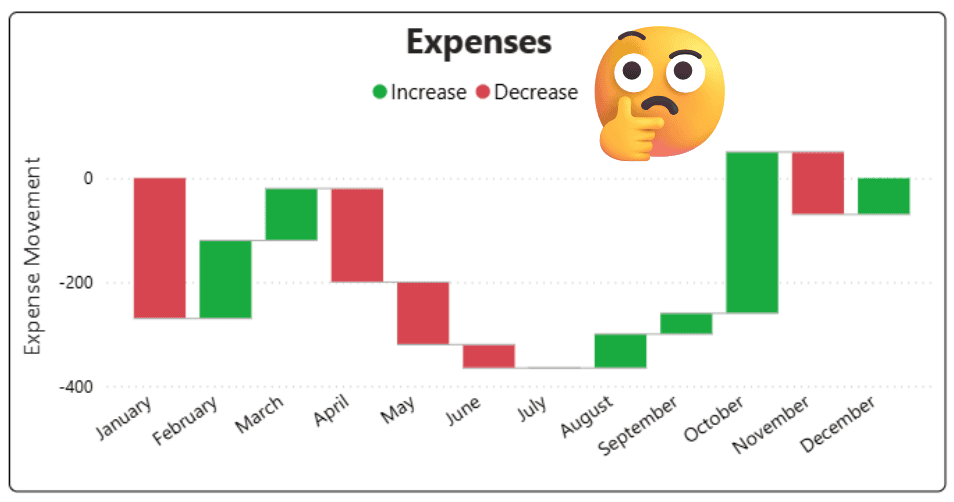
So, if a cost decrease is shown in red, a reader glancing at the chart may read the cost decrease as a problem. Yet costs decreasing are generally viewed as a good thing.
More concerning, when a cost increase appears in green, the increase can be scanned past without the scrutiny it deserves.
Note it’s not that the reader isn’t paying attention. It’s that colour is conveying information before the numbers are even looked at.
Context Changes Everything
Often building charts is straightforward. The tool applies default colours — increases in green, decreases in red — and for a lot of use cases, that works perfectly well.
The issue arises when you step back and ask:
What is this chart actually showing?
When you are looking at revenue or profit, green for an increase makes complete sense. But when you are looking at expenses, the story is different.
Changing the context impacts colour choice and that is the bit that’s easy to miss when you’re in the depths of building a report.
The fix is straightforward: for expense charts, reverse the colours. Red for increases, green for decreases. It takes moments to change, and it means the colours in your chart matches what your audience expect.
But, there are a few caveats …

Neighbouring Charts and Accessibility
Thinking about context does not stop at a single chart, it applies across the entire report. A reader is not interpreting colours chart by chart, they’re interpreting them across the page.
If you place an Income chart next to an Expenses chart, colour meaning can become inconsistent.
An increase in Income is green, and a decrease in Expenses is green.
Both are in line with expectations, but green is now carrying different meanings (increase/decrease). This risks a reader misinterpreting the information in the charts.
Accessibility adds another layer to this. Not all readers perceive red and green clearly, which makes relying on those colours even less reliable.
In these situations, it is worth considering whether using red and green is the right choice, or if an alternative colour scheme would be more appropriate.
The Impact on Business
It is important that the colour and the message you want to get across are considered and aligned because reports are rarely read in ideal conditions.
People are in meetings, under time pressure, making quick decisions.
If the colours don’t align with the message, those quick reads can lead to the wrong conclusion before the numbers are even checked.
It also affects trust. If information in a report can be easily misinterpreted, people can start to lack confidence in the report. They may stop relying on its figures despite the underlying data being correct.
It’s About Telling the Right Story
Colour is not just a design choice. It’s part of how you communicate data.
When the colours align with the context, the chart does its job. When they don’t, the information can be easily misunderstood.
It is worth taking a moment before a report is issued to ask:
If someone glanced at this for five seconds, do the colours help them understand the data — or could they lead them somewhere else?