
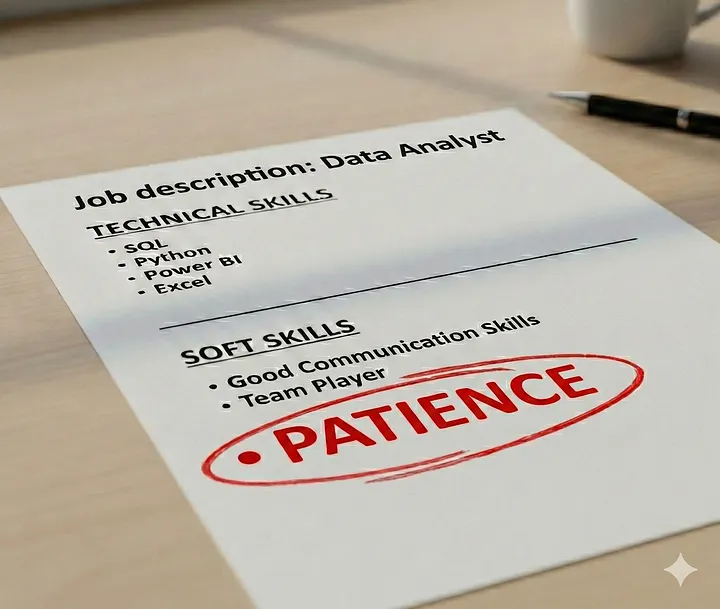
You don’t usually see “patience” listed on a data analyst’s job description. You see requirements for SQL, Power BI, or Python, but not the requirement to sit with a problem until it makes sense. Yet for anyone working with data, patience is effectively the backbone of the work.
There is a constant tension between how fast people want an answer and how long it takes to find a reliable one. People often need reports now, while the reality of a data analyst’s job involves cleaning messy data, questioning assumptions, testing ideas, and working out what the numbers are really trying to say. When these two time expectations clash, the analyst is at risk of being labelled as “slow”.
The illusion of “instant” results
Often in today’s workplace there is a focus on “instant” results which is not helped by the “hype” over the latest tool.
There is the: Learn “everything” you need to know in one day bootcamps. The five-minute demos which show “revolutionary” transformations. The dashboards which can be created “instantly” that promise “game-changing” insights.
At first glance, these demos make everything look easy. But your data isn’t tidy, the questions being asked aren’t clear, and the shortcuts from the demo don’t often apply. And the stakeholders still expect answers immediately, because they’ve just seen it done in minutes elsewhere.
Today it can often feel to an analyst that trying to keep up with new tools, features and latest trends is a full-time job. Learning a new tool well enough to use it responsibly takes repetition, context, and trial and error. Watching a launch video or skimming a blog post gives exposure, not understanding. Real insight comes from spending long enough with a tool to discover where it helps — and where it doesn’t.
Watching a launch video or skimming a blog post gives exposure, not understanding.
Both the workplace and the analyst should acknowledge that to sit in the unknown and learn these tools takes time. It takes patience.
The Tension of “Right vs. Right Now”
In a fast-paced workplace, individuals may exert pressure for immediate answers. Analysts appreciate that deadlines exist, decisions need to be made, and nobody wants unnecessary delays.
When an analyst says, “I need to look into this,” it isn’t avoidance. It is a deliberate step to make sure the answer is reliable. Quick answers can be useful, but they can also be wrong — and once a number is shared, it tends to stick.
Once a number is shared, it tends to stick.
As a data analyst being able to patiently explain that analytical work takes time, can help relieve the pressure when others are pushing to “see” something now in the initial stages of a project. Over time as the data analyst works to build up trust and respect then the expectations of early visibility of output can dissipate.
Once the work is complete the data analyst’s role may not end there. In the workplace adoption of new databases and reports may take time. People often resist moving from the status quo. Reports that initially go unused can become genuinely valuable once people understand how to use them and where they fit into their work. Usefulness often appears gradually through conversation, iteration, and practice — again requiring patience from both the analyst and colleagues.
Give Yourself Permission to Learn
Learning a profession takes time. Analysts need patience with their own development, and workplaces must allow space to grow. Rushing to master everything immediately is counterproductive. Taking the time to gain a deeper understanding now, speeds up work later.
Patience is not laziness. It’s not working slowly. It’s working at the appropriate pace to do the job well.
It can take time to perform analytical work. The data context does need to be understood, data must be cleaned, assumptions checked, correlations explored, queries debugged — sometimes this takes longer than an analyst would like or thinks to themselves it should take.
Data analysts need to feel it’s ok to take time to think or sit with and understand a problem. Thinking time is not a luxury, it is a necessity.
Thinking time is not a luxury, it is a necessity.
Having patience with yourself to learn and improve your capabilities overtime can aid with confidence, integrity, and having trust in your work. In this sense, patience is not the opposite of efficiency. Often, it’s what makes efficiency possible later.
Reclaiming patience as a skill
Patience should be recognised as a core analytical skill, not merely a personality trait. Thinking, learning, interpreting, and understanding take time. Analysts need supportive workplaces and confidence to trust their own pace.
When speed is valued above understanding, organisations risk losing the thinkers — the people who can explain why a result looks the way it does. Let’s take a breath and appreciate patience for what it truly is — a skill that makes good analysis possible.
This article was first published on Medium. Subscribe on Medium for my latest releases - https://medium.com/@paulinecairns
Subscribe to my newsletter where I share practical notes on data, tools, and how people use them.
We respect your privacy. Unsubscribe at anytime.